Every aspiring author reaches this fork in the road. You have a manuscript (or an idea for one), and now you need to decide how it gets into readers' hands. The self-publishing vs traditional publishing debate has been running for over a decade, but the reality in 2026 looks nothing like it did even five years ago.
This guide breaks down both paths honestly. No cheerleading for either side. Just the facts, the numbers, and the trade-offs so you can make the right decision for your book and your career.
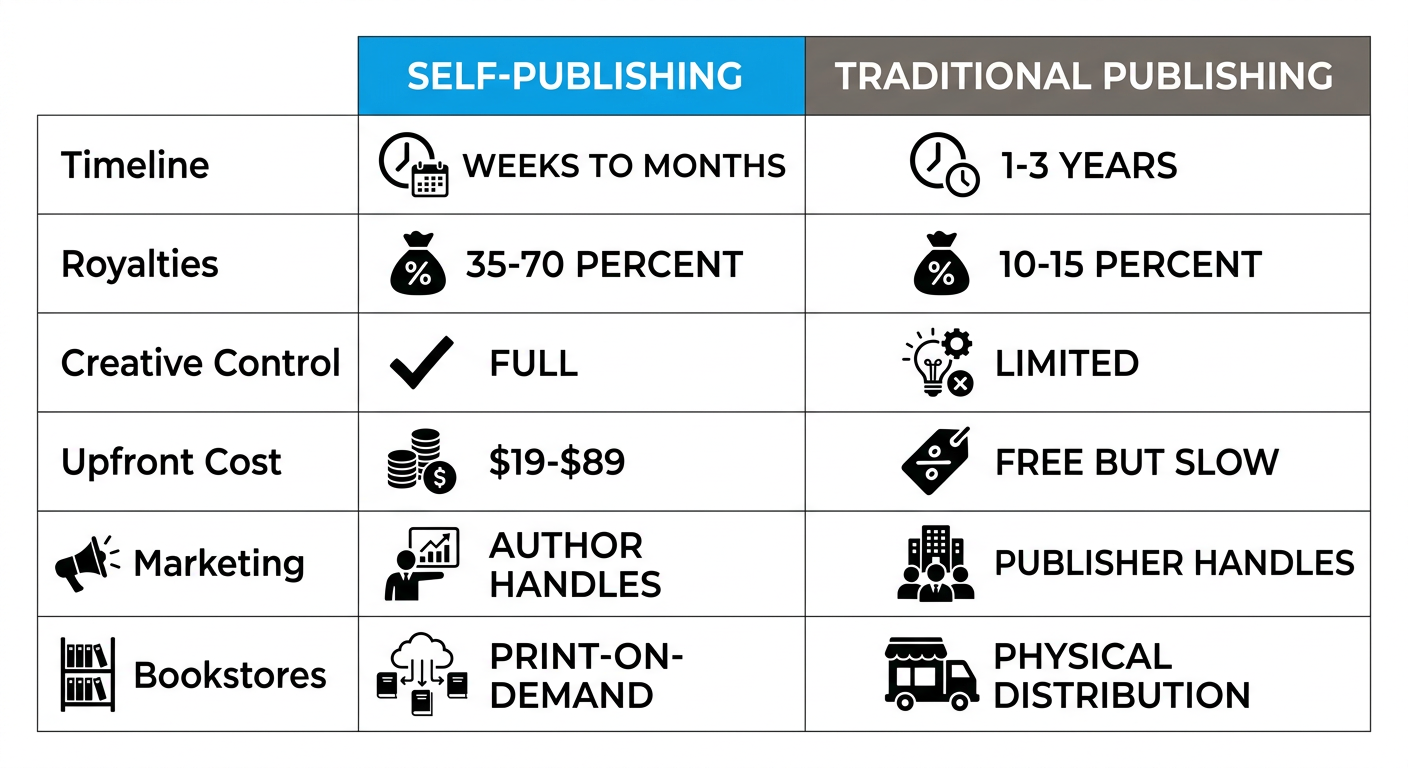
How Traditional Publishing Works
Traditional publishing means a publishing house pays to produce and distribute your book. You don't pay them. They pay you. That sounds great on paper, but getting there is the hard part.
The Process
- Write the full manuscript (fiction) or a book proposal (nonfiction). This alone takes most authors 6-18 months.
- Query literary agents. You send a one-page pitch letter to agents who represent your genre. Response rates hover around 1-3%. Most authors query 50-100 agents before landing one.
- Agent submits to publishers. Your agent sends the manuscript to acquisition editors. This takes 3-12 months. Many agented books still don't sell.
- Publisher offers a contract. If an editor wants your book, you negotiate an advance against royalties. First-time advances range from $5,000 to $25,000 for most genres. Literary fiction and niche nonfiction often see $5,000-$10,000.
- Editing, design, and production. The publisher handles editing, cover design, interior layout, and printing. This takes 12-18 months after signing.
- Publication and distribution. Your book hits bookstores, libraries, and online retailers.
The Timeline
From finished manuscript to bookstore shelf: 1 to 3 years. That's not a typo. If you include the time spent querying agents, many authors wait 2-4 years from "done writing" to "book in hand."
The Money
- Advance: $5,000-$25,000 for most debut authors. Big Six publishers occasionally offer six figures for high-concept books, but that's rare.
- Royalties: 10-15% of list price for hardcovers, 6-8% for paperbacks, 25% of net for ebooks. You don't see royalty checks until the advance earns out. Roughly 70% of traditionally published books never earn out their advance.
- Agent commission: 15% of everything. Your $10,000 advance becomes $8,500.
What You Get
- Bookstore distribution. This is the big one. Traditional publishers have relationships with Barnes & Noble, independent bookstores, airport shops, and library systems that are nearly impossible to replicate independently.
- Professional production at no cost to you. Editing, cover design, typesetting, proofreading.
- Credibility. A traditional publishing deal still carries weight with reviewers, media, and some readers.
- Foreign rights and film/TV potential. Major publishers have sub-rights departments that pitch your book to international markets and entertainment companies.
What You Give Up
- Creative control. The publisher chooses your cover, your title (often), your release date, and your price. You can push back, but they have final say.
- Speed. Years, not months.
- Most of the revenue. After agent fees and publisher splits, you keep roughly 8-12% of each sale.
- Rights. You typically grant exclusive publishing rights for the life of the copyright. Getting your rights back if a book goes out of print involves contractual clauses and sometimes lawyers.
How Self-Publishing Works
Self-publishing means you produce and distribute the book yourself. You are the publisher. Platforms like Amazon KDP, IngramSpark, and Draft2Digital handle printing and distribution. You handle everything else.
The Process
- Write your manuscript.
- Edit it. Hire a professional editor or use AI-assisted editing tools, but the manuscript needs to be polished.
- Design a cover. This is not optional. Covers sell books. You either hire a designer or use a tool that produces professional-quality results.
- Format for publication. Ebook (EPUB/MOBI), paperback (PDF with specific trim sizes), and optionally hardcover. Each format has its own technical requirements.
- Upload to distribution platforms. Amazon KDP is the biggest, but many authors also use IngramSpark for wider distribution.
- Market your book. Nobody will know it exists unless you tell them.
The Timeline
From finished manuscript to published book: 2 weeks to 3 months. Most of that time is editing and cover design. The actual upload-and-publish step takes a day.
The Money
- Royalties: 35-70% on Amazon KDP depending on pricing and distribution choices. A $9.99 ebook at the 70% rate earns you about $6.99 per sale. A paperback earns $2-5 per copy after printing costs.
- No advance. You earn from the first sale, but there's no upfront payment.
- No agent commission. 100% of your royalties are yours.
What You Get
- Full creative control. Your cover. Your title. Your price. Your release date. Every decision is yours.
- Speed to market. Write it, produce it, sell it. No gatekeepers, no waiting.
- Higher per-unit revenue. You keep 4-7x more per book sold than a traditionally published author.
- Your rights, always. You can unpublish, re-publish, change prices, update content, or pull your book at any time.
- Data. You see your sales numbers in real time, not in a royalty statement that arrives six months late.
What You Give Up
- Bookstore distribution. Getting self-published books into physical bookstores is difficult. IngramSpark makes it possible but not easy. Most self-published sales happen online.
- Upfront investment (sometimes). You pay for editing, cover design, and formatting. More on costs below.
- Marketing is 100% on you. No publisher marketing team, no sales force pitching bookstores. You are the marketing department.
- Perceived credibility. The stigma has faded significantly, but some literary circles, review outlets, and award programs still favor traditionally published books.
Costs: A Real Comparison
One of the biggest factors in the self-publishing vs traditional publishing decision comes down to money: what you spend and what you earn.
Traditional Publishing Costs
Technically zero out of pocket. The publisher covers editing, design, printing, and distribution. But the hidden costs are real:
- Time. Two to four years of waiting is two to four years of not earning from your book. If your time has value, this is a significant opportunity cost.
- Lost revenue. You're trading 85-90% of each sale for the services the publisher provides.
- Career risk. If your traditionally published book underperforms, publishers track those numbers. A "failed" first book can make it harder to sell a second one.
Self-Publishing Costs (Traditional Approach)
Hiring freelancers for everything typically runs $2,000-$5,000 for a solid result:
- Professional editing: $800-$2,500
- Cover design: $300-$1,200
- Interior formatting: $200-$500
- ISBN: $125 (single) or ~$6 each in bulk
- Marketing materials: $200-$500
For a deeper breakdown, see our complete guide to self-publishing costs.
Self-Publishing Costs (AI-Assisted)
AI tools have compressed these costs dramatically. Platforms like BookSmith handle outline generation, chapter writing, cover creation, formatting, and export for $19-$89 depending on book length. That puts professional-quality book production within reach of almost anyone.
You still might want a human editor for a final pass, especially for fiction. But the baseline cost of going from idea to publish-ready files has dropped by 90%+ compared to the traditional freelancer route.
Revenue: Let's Do the Math
Numbers don't lie. Here's what each path looks like for a $14.99 ebook that sells 1,000 copies in its first year.
Traditional Publishing
- List price: $14.99
- Publisher net (after retailer discount): ~$10.49
- Author royalty (25% of net): $2.62 per sale
- Agent commission (15%): -$0.39 per sale
- Author earns: $2.23 per sale = $2,230 total
But remember: you already received a $10,000 advance. You won't see royalty checks until you've sold about 4,500 copies. Most debut novels don't hit that number.
Self-Publishing (Amazon KDP)
- List price: $9.99 (lower price, higher conversion)
- Author royalty (70% rate): $6.99 per sale
- No agent, no publisher split
- Author earns: $6.99 per sale = $6,990 total
- Minus production costs ($19-$89 with AI tools, or $2,000-$5,000 with freelancers)
At 1,000 copies, the self-published author takes home more. Significantly more if they used AI tools to keep production costs low. At higher volumes, the gap widens further.
The traditional author "wins" only if they received a large advance on a book that never earns out. That's good for the author in the short term, but it makes selling your next book harder.
Who Should Choose Traditional Publishing
Traditional publishing is not dead and it's not obsolete. For certain authors and certain books, it's still the best path. Consider it if:
- You want physical bookstore distribution. If seeing your book on a Barnes & Noble shelf matters to you (personally or strategically), traditional is the most reliable way to get there.
- You write literary fiction. Literary awards, review coverage in major outlets, and academic recognition still skew heavily toward traditional publishing.
- You have a strong platform already. A large social media following, speaking career, or media presence makes you attractive to publishers who will offer bigger advances and invest more in marketing.
- You don't want to run a business. Self-publishing is entrepreneurship. If you want to write and only write, a traditional deal lets someone else handle the rest.
- Your book needs institutional credibility. Academic texts, certain nonfiction categories, and books intended to support a professional practice may benefit from a publisher's imprint.
Who Should Choose Self-Publishing
Self-publishing has gone from fringe to mainstream. The majority of full-time fiction authors earning six figures are self-published. It makes sense if:
- You want to control the business. Pricing, covers, release timing, marketing strategy. You call every shot.
- You write in commercial genres. Romance, thriller, sci-fi, fantasy, mystery, self-help, and how-to books do exceptionally well in self-publishing, where readers buy primarily through Amazon.
- You plan to write multiple books. Self-publishing rewards volume. Each new book drives sales of your backlist. You build a catalog that compounds over time.
- You value speed. If your book is timely (tied to a trend, current event, or seasonal opportunity), waiting two years for traditional publication means missing the window.
- You want to maximize revenue per reader. The per-unit economics are not close. Self-published authors earn 3-7x more per sale.
- You have a specific audience. Niche nonfiction (a book for real estate agents in Texas, a guide to fermenting hot sauce, a workbook for anxiety in teens) often does better self-published because you know exactly how to reach your readers.
The Hybrid Approach
It's not always either/or. Many successful authors publish both ways:
- Traditionally publish your "prestige" book and self-publish everything else. Use the traditional deal for credibility and bookstore placement, then self-publish in genres or formats where speed and control matter more.
- Self-publish first to prove demand. Several authors have landed traditional deals after self-published books took off. Andy Weir (The Martian), E.L. James, and Hugh Howey all started indie.
- Split by format. Some authors traditionally publish print editions (for bookstore distribution) while retaining ebook and audiobook rights to self-publish.
- Use traditional for your home market and self-publish internationally, or vice versa.
Hybrid publishing is increasingly common among career authors. The key is understanding what each path offers and choosing the right one for each project.
How AI Has Changed the Equation
The biggest knock against self-publishing used to be quality. Readers (fairly) associated indie books with bad covers, poor editing, and rough formatting. Producing a professional book required either significant skill or significant money.
AI tools have eroded that barrier. In 2026, a first-time author can:
- Generate a structured, professionally outlined book from a concept
- Produce well-written, coherent chapters with consistent voice and tone
- Get professional cover designs without hiring a designer
- Export KDP-ready files (EPUB, PDF, DOCX) formatted to industry specifications
- Put together marketing copy, book descriptions, and keyword strategies
All of this for under $100 and within days rather than months.
This matters because it removes the main argument for traditional publishing's production services. If you can get professional-quality editing, design, and formatting without a publisher, the trade-off shifts. You're no longer choosing between "professional but slow and expensive" and "fast but amateur." You're choosing between "professional, fast, and you keep the rights" and "professional, slow, and you share the revenue."
That said, AI tools are not a magic wand. The best results still come from authors who bring genuine expertise, a clear vision for their book, and a willingness to review and refine AI-generated content. The tools handle production. You provide the substance.
Making Your Decision
There is no single right answer. But this framework helps cut through the noise:
Ask Yourself These Questions
- How important is bookstore placement? If it's essential, lean traditional. If most of your readers buy online, lean self-pub.
- How patient are you? Traditional publishing rewards patience. Self-publishing rewards action.
- Do you want to run a business or focus on writing? Self-publishing is a business. You handle marketing, pricing, cover strategy, and release planning. Some authors love this. Others hate it.
- What genre are you writing? Commercial genres (romance, thriller, fantasy, self-help) have well-established self-publishing markets. Literary fiction and academic work still benefit from traditional imprints.
- How many books do you plan to write? One book? Either path works. A catalog of 5-10 books? Self-publishing's compounding economics become very attractive.
- What are your financial expectations? If you need money upfront, an advance helps. If you want to maximize long-term earnings, self-publishing typically wins.
The Bottom Line
Traditional publishing is a good path for authors who value prestige, bookstore distribution, and a hands-off production process, and who are willing to wait years and accept lower per-unit earnings for those benefits.
Self-publishing is a good path for authors who value speed, control, and higher earnings, and who are willing to handle (or outsource) the business side of publishing.
Neither path guarantees success. Both require a good book. The difference is how it gets from your head to the reader's hands, how long that takes, and how the money splits when it does.
If you're leaning toward self-publishing and want to see how far AI-assisted production has come, try BookSmith free — you'll get a complete book outline before you pay anything.