Your Book Description Is Your Most Important Sales Tool
A reader lands on your Amazon listing. They glance at your cover, skim the title, and then their eyes drop to the description. You have roughly ten seconds before they click "Buy Now" or hit the back button.
Most self-published authors treat it as an afterthought, a quick plot summary or dry rundown of contents. Then they wonder why sales never materialize. Your book description is not a summary. It is a sales page. Writing a sales page is a different skill than writing a book.
The Anatomy of a Book Description That Converts
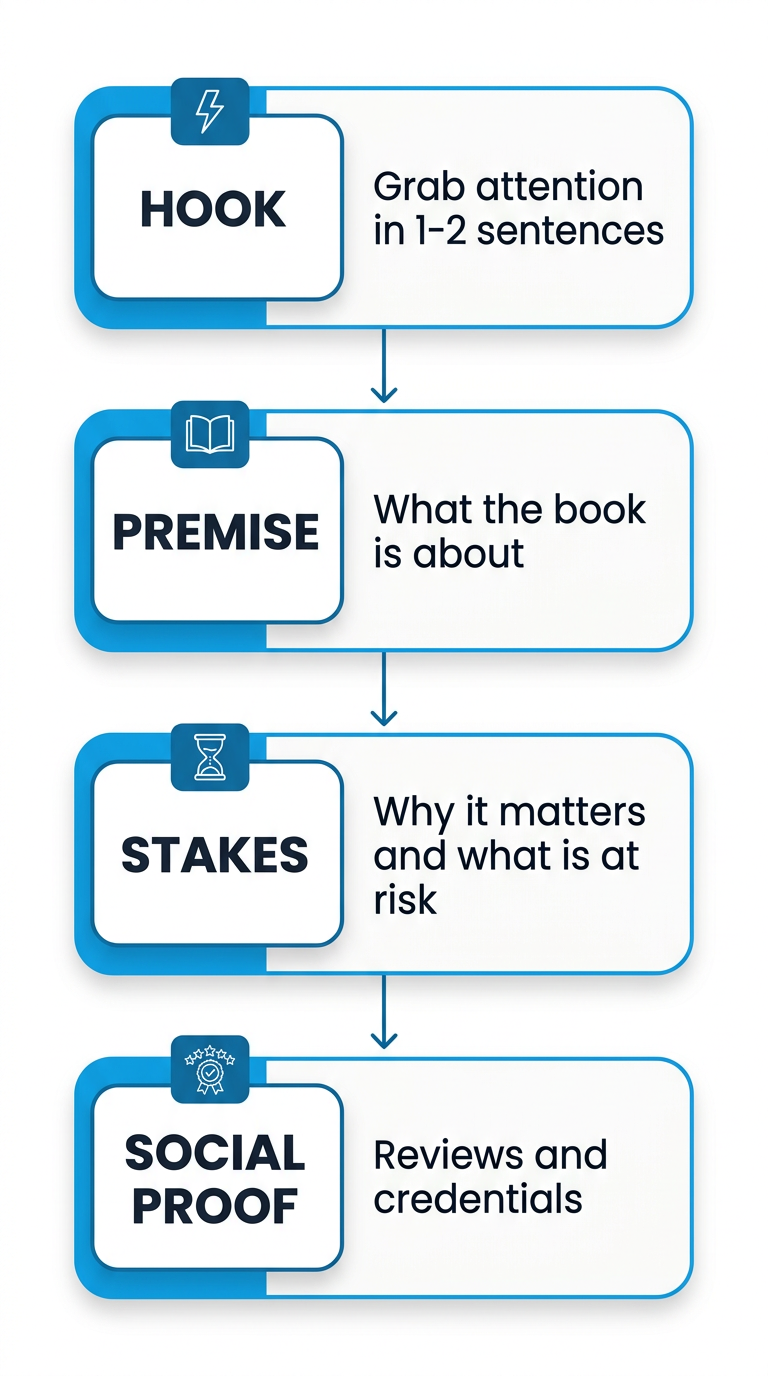
Strong Amazon book descriptions all follow the same structure. A thriller looks different from a self-help book on the surface, but the bones are identical:
- The hook: one or two sentences that stop the scroll. This is the single most important line you will write. It should create an immediate emotional reaction: curiosity, fear, excitement, recognition.
- The premise: what is this book actually about? Set up the situation, the character, or the problem. Give just enough context that the reader understands what they are getting into.
- The stakes: why should the reader care? What is at risk? What will they gain or lose? This is where you create urgency and emotional investment.
- Social proof (optional but powerful): a short quote from a review, an award mention, a bestseller tag, or a comparison to a well-known author or book. This reduces perceived risk for the buyer.
The order matters. Lead with the hook. Build with premise and stakes. Close with proof. Readers skim from top to bottom, and Amazon truncates long descriptions behind a "Read more" fold. Everything above that fold needs to earn the click.
The Fiction Formula: Setup, Conflict, Question
Fiction descriptions follow a specific rhythm. You are not summarizing your plot. You are setting up a situation, introducing a conflict, and then asking a question that can only be answered by reading the book.
Step 1: The Setup
Introduce your protagonist and their world in one to two sentences. Make the reader see this person. Use specific, concrete details rather than vague adjectives.
- Weak: "Sarah is a determined woman facing challenges."
- Strong: "Sarah Chen hasn't slept in four days. The last person who called her phone is now missing."
Step 2: The Conflict
What goes wrong? What impossible choice does your character face? The conflict should feel personal and specific. Avoid describing the plot beyond the first act. You are selling the promise of a story, not delivering a book report.
Step 3: The Question
End with an unanswered question that creates tension. This is the gap between what the reader knows and what they need to find out. It should be impossible to answer without reading the book.
Never give away the ending. Never reveal the twist. Never resolve the tension. Your description exists to open a loop in the reader's mind. The book closes it.
Fiction Example
A psychological thriller example:
The last voicemail on Mara's phone is from her sister. The problem is, her sister has been dead for six months.
When forensic linguist Mara Voss receives a voicemail that matches her late sister's voice with 99.7% certainty, she does what anyone would do: she calls back. The number belongs to a cabin in rural Oregon that burned to the ground in 2019. But someone is still answering.
As Mara follows the trail from a university lab to a military contractor she was never supposed to know about, she begins to suspect that her sister's death was not an accident — and that the people responsible know Mara is looking.
What she finds in that cabin will change everything she believes about her family. The question is whether she will survive long enough to tell anyone.
Hook that creates curiosity. Specific protagonist. Escalating stakes. Unanswered question. It never tells you what happens. That is the point.
The Nonfiction Formula: Problem, Promise, Proof, Plan
Nonfiction descriptions work differently. Your reader has a problem, and they want to know if your book solves it. Four parts:
Problem
Name the pain point directly. Your reader should feel seen in the first two sentences. If they are struggling with something, articulate it better than they can themselves.
Promise
What will the reader walk away with after finishing the book? Be specific. "You'll learn marketing" is weak. "You will have a 90-day launch plan that has generated over $50,000 in book sales for first-time authors" is strong.
Proof
Why should the reader trust you? Mention credentials, results, endorsements, or the research behind your methods. Keep it to one or two lines. If you lack traditional credentials, lean on results or the depth of your research.
Plan
Give the reader a glimpse of what is inside. A short bulleted list of topics works well here. It signals structure and substance, telling the reader: "This is organized. This is practical. This will not waste your time."
Nonfiction Example
You wrote the book. Nobody is buying it.
Your sales dashboard shows the same number every day: zero. The problem is not your book. It is your launch.
This book gives you the exact launch system used by authors who consistently hit #1 in their categories, without ads, without a mailing list, and without an existing audience.
Inside, you will learn:
• The 3 categories where your book can realistically compete
• A pre-launch review strategy that generates 15+ reviews in week one
• A pricing ladder that maximizes both rank and revenue
Amazon HTML Formatting That KDP Actually Supports
Amazon's book description field supports a limited set of HTML tags. Using them makes your description much easier to read. A wall of unformatted text looks amateur and nobody wants to scan it.
KDP allows these tags in book descriptions:
- <b> and </b> for bold text. Use this for your hook line and key phrases. Bold text draws the eye and creates visual hierarchy.
- <i> and </i> for italic text. Use sparingly for book titles, emphasis, or review quotes.
- <br> for line breaks. This is your most important formatting tool. Use line breaks to create white space between paragraphs. Without them, your description becomes an unreadable block.
- <h4> and </h4> for subheadings. Use for section breaks within longer descriptions. Do not overuse.
Amazon does not support bullet point HTML (<ul>, <li>). If you want bullet points, use Unicode characters like • (bullet) or — (em dash) followed by a <br> tag. The nonfiction example above demonstrates this pattern.
Worth knowing: Amazon strips most formatting from the mobile Kindle app and shows plain text only. Your description needs to read well with and without formatting. Write it plain first, then add HTML.
Length: The 150 to 300 Word Sweet Spot
Amazon allows up to 4,000 characters in a book description, but that does not mean you should use all of them. The best-performing descriptions land between 150 and 300 words:
- Under 100 words signals that you did not take the listing seriously. It looks thin and unprofessional.
- 150 to 300 words gives you enough room to execute the hook-premise-stakes structure without losing the reader.
- Over 400 words risks burying your best material below the "Read more" fold. Most readers will never click to expand.
Amazon shows roughly the first 300 characters before truncating on desktop, and even less on mobile. Front-load your strongest material. The hook must appear above the fold.
Common Mistakes That Kill Book Descriptions
These are the patterns that consistently underperform. If your current description matches any of these, rewrite it.
- Writing a summary instead of a sales pitch. Nobody buys a book because they already know what happens. They buy because they need to find out.
- Giving away the ending. For fiction, never reveal the resolution. For nonfiction, never give away your core framework. Tease it. Name it. Leave enough unsaid.
- No emotional hook. Starting with "This book is about..." is clinical. Your first line should provoke curiosity, fear, recognition, or excitement.
- Making it too long. Over 400 words and you are diluting your strongest lines. Every sentence must build curiosity or establish credibility.
- Generic language. "A gripping tale," "an unforgettable journey," "a must-read." These phrases could describe any book ever written. Specificity sells.
Before and After: A Real Rewrite
Take a weak description and rewrite it using the principles above. Watch what changes.
Before (Weak)
This is a story about a young woman named Emma who lives in a small town. She works at a bookshop and dreams of becoming a writer. One day she meets a mysterious stranger who changes her life forever. This gripping tale of love, loss, and redemption will keep you turning pages until the very end.
No hook. No specificity. No stakes. "Mysterious stranger" and "gripping tale" are filler. Nothing is at risk. No question is left unanswered.
After (Strong)
Emma Zhao has not written a word in three years. The rejection letter that broke her is still taped to her bathroom mirror.
She has settled into a quiet life running the only bookshop in Harlan, Oregon — a town where nothing changes and nobody expects much. Then a man walks in asking for a book that does not exist. A book with her name on the cover.
He says he is a publisher. He says he read her manuscript, the one she burned on the back porch the night she quit. He says he wants to buy it. The problem is, Emma never sent it to anyone.
As she tries to figure out how a stranger has a copy of a manuscript that no longer exists, she is pulled back into the life she abandoned and closer to a truth about her writing that she never wanted to face.
Same premise. The rewrite has a concrete hook, a specific protagonist, escalating mystery, and an unresolved question. The reader cannot get the answer without buying the book.
Writing Your Description: A Quick Process
- Write your hook first. Try ten versions. Pick the one that would make you stop scrolling.
- Identify the core tension. One sentence that captures the central conflict, question, or problem.
- Draft using the formula above. Fiction: setup, conflict, question. Nonfiction: problem, promise, proof, plan.
- Cut to 200 words. Every sentence must either build curiosity or establish credibility. If it does neither, delete it.
- Read it out loud. If it sounds like a Wikipedia article instead of a pitch to a friend, rewrite.
- Add HTML formatting and test against Amazon's "Read more" fold. Your hook must be visible before the cutoff.
How BookSmith Handles Book Descriptions
Writing a great book description is hard. It takes copywriting skill, which is a different craft from writing a book. BookSmith handles this for you as part of the publishing pipeline.
When your manuscript is complete, BookSmith generates multiple description variants tailored to your genre and target audience:
- Short-form blurb (under 100 words) for social media and quick pitches
- Medium-form description (150-200 words) optimized for Amazon's above-the-fold display
- Long-form marketing copy (250-300 words) with HTML formatting ready for KDP
- Back cover copy formatted for print editions
Each variant follows the formulas described in this article (hook, premise, stakes) and is calibrated to your specific book. The descriptions are generated alongside your Amazon keywords and category recommendations, so your entire listing is optimized as a single unit rather than piecemeal.
You review and edit every description before it goes live. BookSmith gives you the starting point. You have final say.
Your Description Is Worth the Effort
Most authors spend months writing their book and minutes writing their description. That ratio is backwards. The description is where purchase decisions happen.
Lead with a hook. Build tension through premise and stakes. Close with an unanswered question. Keep it under 300 words. Format it with HTML. Test it against the fold.
If you are ready to publish on Amazon KDP, your description is the single most important piece of text on your listing. Get it right, and everything else works harder: your keywords, your categories, your cover. Get it wrong, and none of it matters.